🤖 Circuit Aide — AI-Powered Hardware Design Agent
Overview
Circuit Aide is an AI-powered hardware design agent that helps users transform an idea into a complete, practical electronic device.
Instead of requiring users to independently research components, design circuits, write firmware, develop mechanical enclosures, and document assembly procedures, Circuit Aide brings these activities together into a unified, AI-assisted hardware development workflow.

Users describe the device they want to build in natural language. Circuit Aide then helps translate those requirements into an interconnected set of engineering outputs, including:
Circuit architecture and schematics
Component recommendations and Bill of Materials (BOM)
Embedded firmware
3D mechanical models
Step-by-step assembly instructions
The goal is to reduce the complexity of hardware development while maintaining a workflow that can scale from early experimentation to more advanced engineering projects.
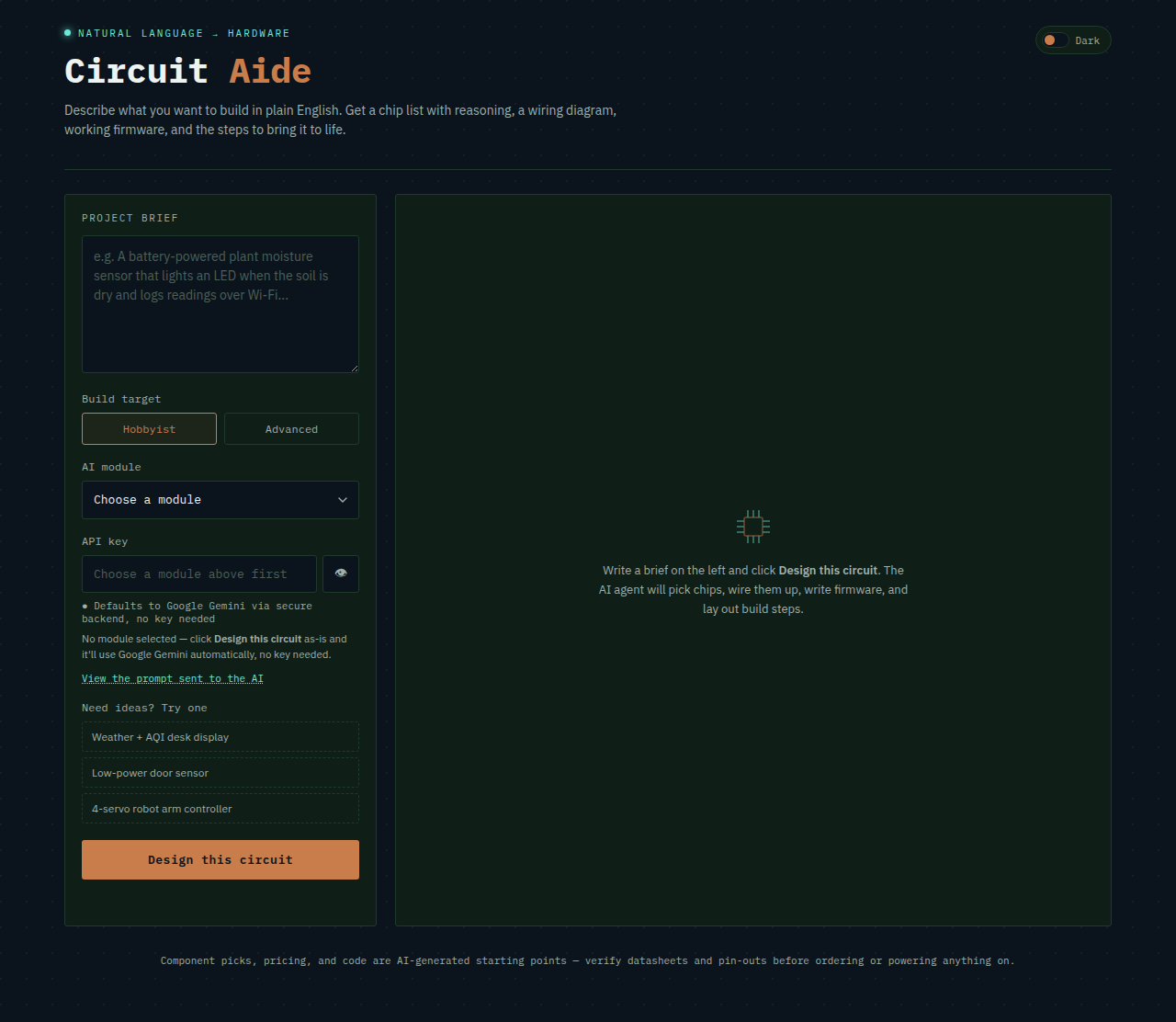
💡 From Idea to Complete Device
Circuit Aide is designed to support the complete hardware development lifecycle:
Idea → Requirements → Circuit → Components → Firmware → Mechanical Design → Assembly → Working Device
A user can provide as much detail as required, including:
Device functionality
Electrical requirements
Performance targets
Component preferences
Size and form-factor constraints
Power requirements
Communication interfaces
Environmental constraints
Cost targets
Manufacturing considerations
Circuit Aide uses this information to develop a coherent hardware design and generate the supporting artifacts required to build and evaluate the device.
🧑💻 Development Modes
Circuit Aide supports different levels of technical depth depending on the user’s experience and project requirements.
Hobbyist
A simplified workflow intended for:
Makers
Students
First-time hardware developers
Experimenters
DIY electronics enthusiasts
The Hobbyist experience prioritizes accessibility, clear explanations, practical component choices, and guided assembly.
Advanced
A more detailed workflow intended for:
Experienced hardware developers
Embedded engineers
Electronics engineers
Professional product developers
The Advanced experience can expose greater technical detail, design constraints, engineering assumptions, and implementation considerations.
⚡ Hardware Design Outputs
Each Circuit Aide project is composed of multiple interconnected outputs. Rather than treating the schematic, firmware, BOM, and mechanical design as independent artifacts, the system aims to keep them consistent with the same underlying device requirements and architecture.
- 🔌 Circuit Architecture & Diagram
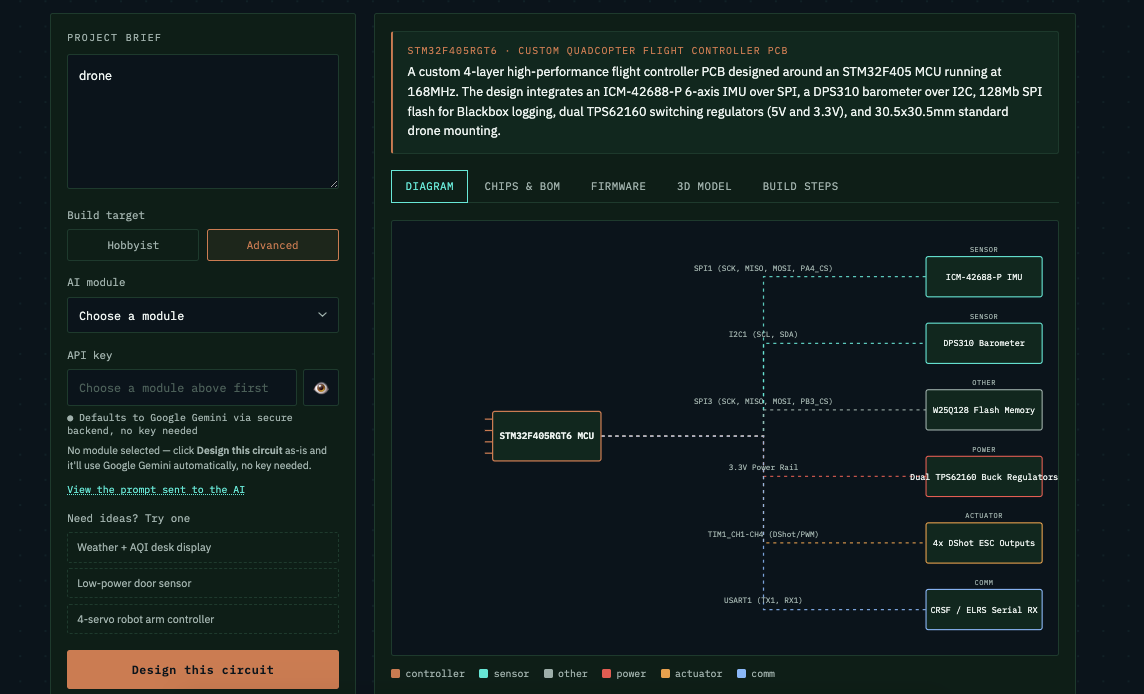
Circuit Aide generates a structured representation of the electronic system and organizes it into functional blocks.
For example, a drone design may be decomposed into:
Controller
Sensors
Power Management
Communication
Actuators
Supporting Circuitry
This block-oriented architecture provides a high-level understanding of the system before moving into individual component connections.
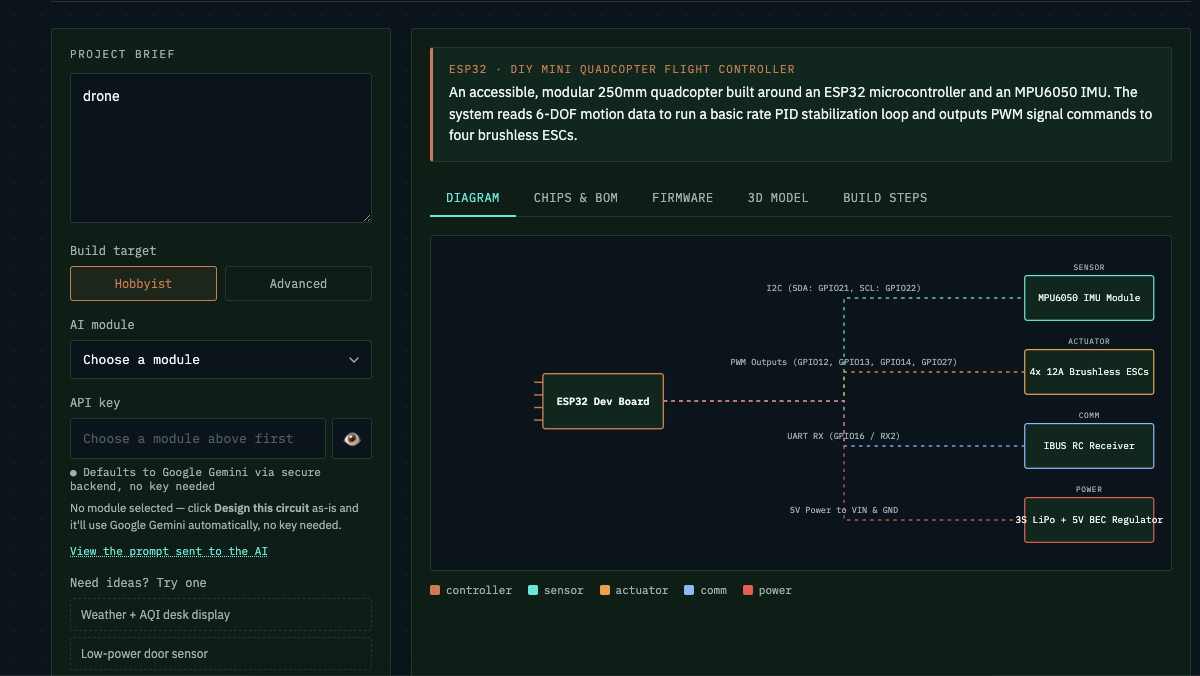
The resulting circuit representation helps users understand:
What each subsystem does
Which components interact
How power is distributed
How signals flow through the system
How major functional blocks are interconnected
The objective is to make complex electronics easier to inspect, modify, and implement.
- 🧰 Components & Bill of Materials
Circuit Aide generates a component list and Bill of Materials (BOM) corresponding to the proposed design.
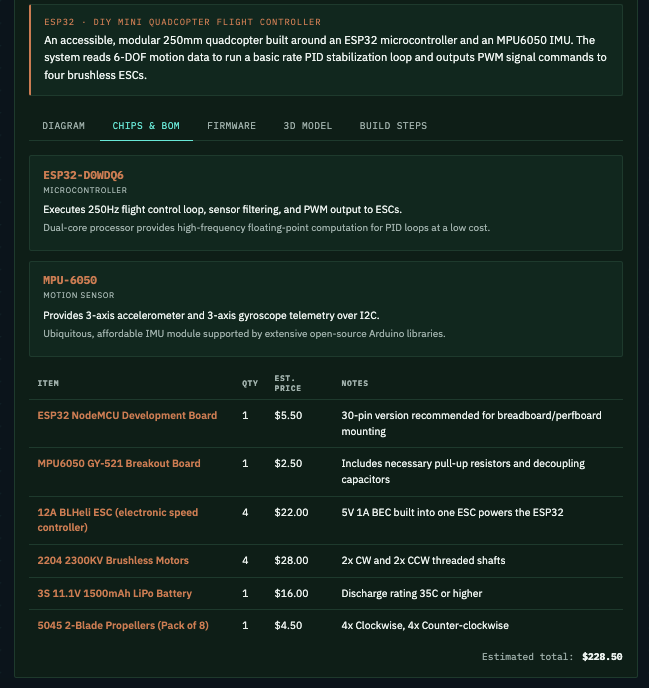
The BOM can include:
Field Description
Component Name of the required part
Type Resistor, MCU, sensor, regulator, connector, etc.
Recommendation Suggested chip or component
Description Short technical description
Quantity Number of required units
Estimated Price Approximate component cost
Role Purpose of the component within the system
The BOM is intended to answer two fundamental questions:
What do I need to build this device?
Why is each component required?
Component selection can take into account the project’s functional requirements, constraints, and development level.
- 💻 Firmware
Circuit Aide can generate firmware corresponding to the proposed hardware architecture.
Instead of beginning with an empty development environment, users receive an initial implementation based on the selected microcontroller, peripherals, sensors, communication interfaces, and other hardware defined by the design.
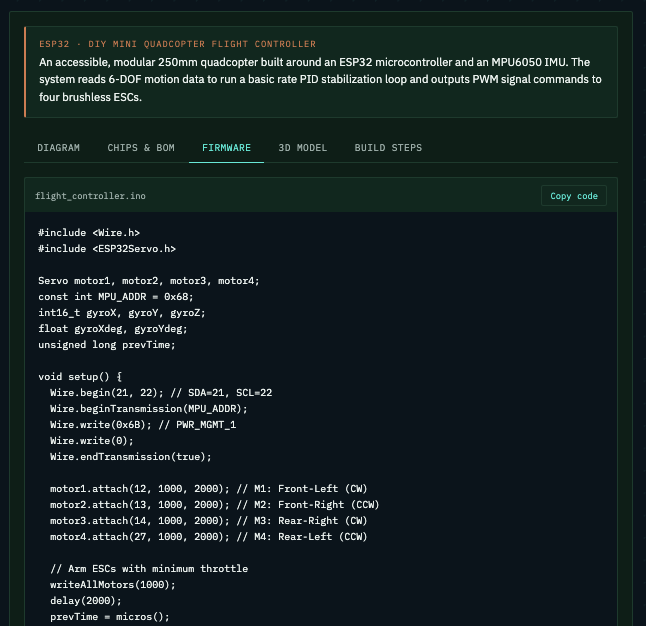
Generated firmware may include functionality such as:
Hardware initialization
GPIO configuration
Sensor interfaces
Communication protocols
Control logic
Peripheral drivers
Device configuration
Main application logic
The firmware is intended to provide a starting point that users can inspect, test, modify, and extend.
- 🧊 3D Mechanical Model
Circuit Aide extends beyond electronic design into the physical construction of the device.
The system can generate a 3D representation of the proposed enclosure or device structure, allowing users to visualize the relationship between the electronics and the physical form factor.
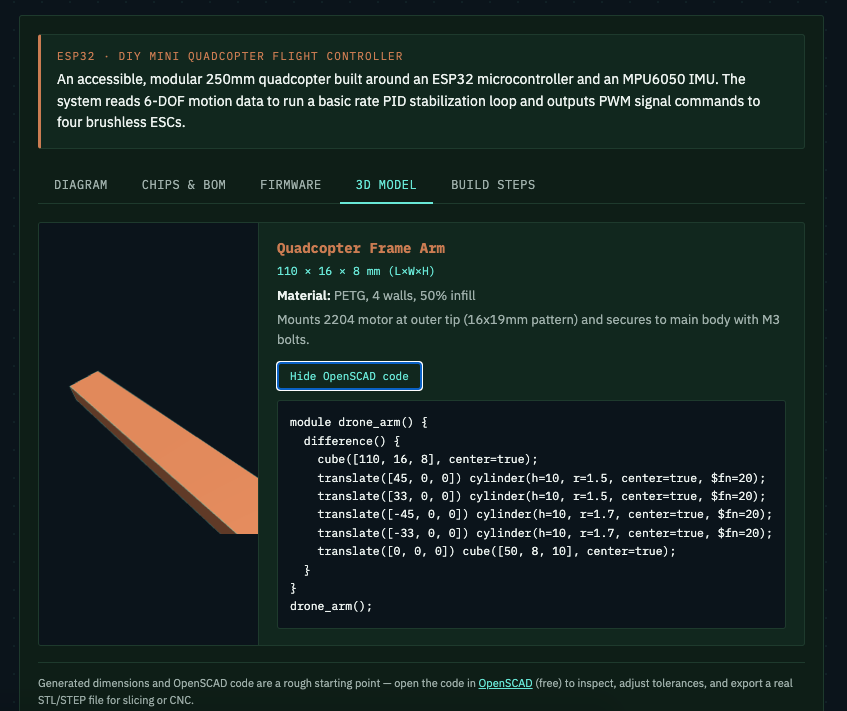
The underlying mechanical design is provided as OpenSCAD-compatible code, enabling users to:
Modify dimensions
Adjust mounting features
Change enclosure geometry
Customize the physical appearance
Adapt the design for different components
Export the model for further manufacturing workflows
This creates a direct connection between electrical architecture and mechanical product design.
- 🔧 Build Instructions
Circuit Aide converts the generated design into a practical assembly workflow.

Build instructions can guide users through:
Obtaining the required components
Preparing the electronics
Assembling individual subsystems
Connecting components and modules
Installing the generated firmware
Configuring the device
Completing mechanical assembly
Testing the completed system
The objective is to turn the generated design into an actionable build process rather than leaving the user with only a schematic and component list.
🤖 AI Model & Tool Ecosystem
Circuit Aide is designed as a flexible AI development environment rather than being dependent on a single AI provider.
The platform can integrate general-purpose AI models and specialized hardware-development tools across different stages of the workflow.
Potential AI capabilities include:
ChatGPT
Claude
Gemini
Flux AI
Cursor
Copilot
Specialized hardware and simulation tools can also be incorporated, including:
Circuit Mind
Wokwi
This architecture allows different models and tools to be applied to different tasks instead of forcing the entire workflow through a single AI system.
🧠 Default AI Model
Google Gemini is the default AI model used by Circuit Aide.
Users can also provide their own API keys when they prefer to use their own AI accounts, billing arrangements, models, or configurations.
This provides flexibility for both individual users and more advanced development environments.
🔗 End-to-End Hardware Development
Traditional hardware development requires engineers to work across multiple specialized domains.
A single device may require knowledge of:
Electronic circuit design
Component selection
Schematic development
PCB design
Embedded programming
Power management
Communication protocols
Mechanical design
Enclosure development
Manufacturing
Assembly and testing
Circuit Aide aims to connect these domains through a single AI-assisted workflow.
Instead of treating each engineering activity as an isolated task, Circuit Aide creates a chain of related outputs derived from the same project requirements.
User Requirements
│
▼
System Architecture
│
├───────────────┐
▼ ▼
Circuit Design Components / BOM
│ │
├───────┬───────┘
▼ ▼
Firmware Mechanical Design
│ │
└───┬───┘
▼
Build Instructions
│
▼
Working Device
This architecture is intended to reduce context switching and make the transition between engineering disciplines more seamless.
💬 User Experience
Circuit Aide is designed around a natural-language-first interaction model.
A user can start with a simple description such as:
“I want to build a small environmental monitor that measures temperature, humidity, and air quality, displays the results, and runs from a rechargeable battery.”
The system can then progressively translate that idea into engineering requirements, architecture, components, firmware, mechanical design, and assembly instructions.
Users can refine the design by adding constraints or changing requirements at any stage.
For example:
Change the microcontroller
Reduce the target cost
Add wireless connectivity
Increase battery life
Change the enclosure dimensions
Replace a sensor
Add a display
Modify the operating voltage
The design can then be regenerated or updated around those requirements.
🎯 Design Philosophy
Circuit Aide is built around several core principles.
Accessibility
Hardware development should not require users to master every engineering discipline before they can build something.
Integration
Circuit design, software, component selection, mechanical design, and assembly should be connected rather than treated as isolated workflows.
Explainability
Generated designs should communicate not only what was selected, but also why components and architectural decisions are being used.
Iteration
Hardware development is inherently iterative. Users should be able to modify requirements and rapidly explore alternative designs.
Practicality
The final output should be useful for building a real prototype, not merely producing a conceptual design.
Extensibility
Advanced users should be able to inspect, modify, and export the generated artifacts rather than being locked into an opaque workflow.
❓ Why Circuit Aide?
Existing electronics design platforms and AI-assisted hardware tools can be highly effective at individual stages of development. However, building a complete device typically requires users to move between multiple specialized applications and workflows.
Circuit Aide takes a broader approach.
Rather than focusing primarily on circuit design, it aims to provide an end-to-end AI hardware development environment.
The central workflow is:
Describe the device you want to build, and Circuit Aide helps turn that description into a complete hardware project.
The system connects:
Requirements → Architecture → Circuit → BOM → Firmware → 3D Model → Assembly
This approach allows beginners to enter hardware development through natural language while giving experienced engineers a unified environment for accelerating early-stage design and prototyping.
👥 Target Users
Circuit Aide is intended for a broad range of hardware developers.
User Primary Value
Hobbyists Guided development from idea to prototype
Students Practical learning across electronics and embedded systems
Makers Faster experimentation and project development
Engineers Accelerated architecture and implementation workflows
Hardware Startups Faster prototyping and design iteration
Product Developers Unified electronic and mechanical development
🚀 Product Vision
Circuit Aide aims to become an AI hardware design agent for everyone—from someone building their first electronic project to professional engineers developing sophisticated connected devices.
The long-term vision is to make hardware development feel less like navigating a collection of disconnected engineering tools and more like collaborating with an intelligent engineering assistant.
A user provides the requirements.
Circuit Aide helps:
Reason about the architecture
Select components
Generate implementation artifacts
Explain the design
Guide the user toward a physical prototype
From an idea in natural language to a complete, buildable device.